




Thank you! Your submission has been received!
Oops! Something went wrong while submitting the form.



Most organizations focus on building AI Models.
Far fewer focus on how they'll ensure it continues performing reliably.
The challenge is no longer whether AI can generate responses. It's whether those responses remain reliable across users, scenarios, and business conditions.
It may provide the correct information but use the wrong tone, miss critical context, or fail to align with business intent. At enterprise scale, these inconsistencies become business risks that affect customer experience, compliance, trust, and operational efficiency.
This is where AI evaluations, or AI Evals, become essential.
AI Evals go beyond measuring whether a system can generate a response. They measure whether it generates the right response consistently across different users, dimensions, regions, languages, and business scenarios.
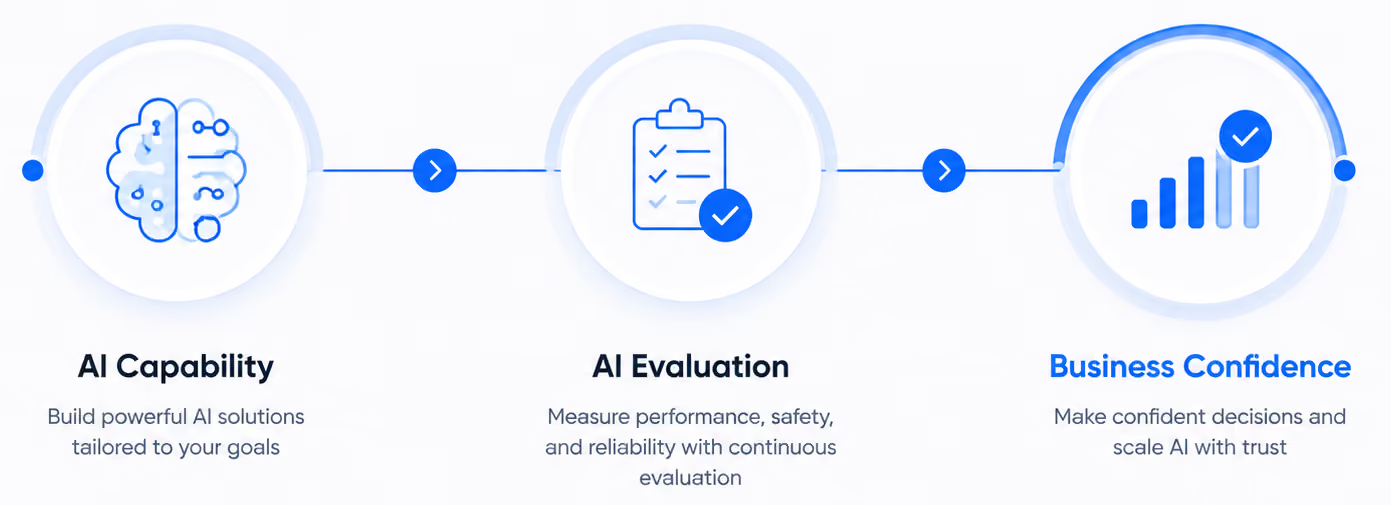
A common misconception is that AI evaluation is simply checking whether the response is correct. In reality, enterprise evaluation measures whether a response meets business expectations as well as user expectations.
Consider a customer asking:
"Where's my order?"
An answer may be technically accurate and still create a poor experience.
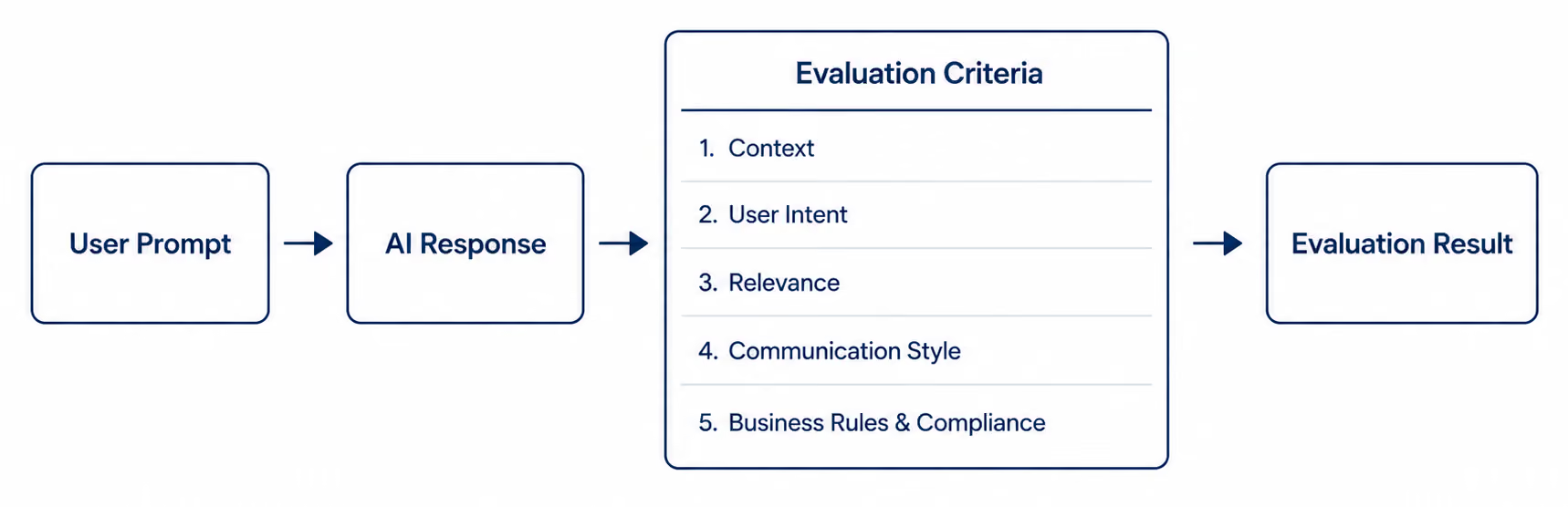
A robust evaluation framework examines five dimensions:
1. Context: Did the system retrieve the correct order information, delivery timeline, and regional details?
2. Intent: Did it recognize that the customer is seeking reassurance, not just tracking data?
3. Relevance: Did it provide meaningful next steps or proactively explain a delay?
4. Tone: Did it reflect the organization's customer experience standards and brand voice?
5. Consistency: Would the response maintain the same quality across locations, languages, channels, and edge cases?
Most enterprise AI failures occur when one of these dimensions breaks, even when the answer itself is technically correct.
Together, these dimensions determine whether an interaction succeeds from a business perspective, not just a technical one.
A response can be accurate and still fail if it lacks empathy, misses context, or creates an inconsistent customer experience.
Enterprise AI isn't evaluated on answers alone. It's evaluated on outcomes.
Effective AI evaluation is not a launch milestone.
It's an operational discipline.
Leading organizations follow a continuous evaluation lifecycle:
Define Success:
Start by identifying the business outcomes that matter. Determine the scenarios, datasets, quality standards, and expected behaviors that define success for the use case. Success criteria should be tied not only to model performance, but also to customer experience, operational efficiency, compliance, and business value.
Build Evaluation Datasets:
Create representative evaluation datasets that reflect real-world interactions, business workflows, edge cases, exceptions, and high-risk scenarios. These datasets become the foundation for measuring AI quality, ensuring the system is tested against the situations it will encounter in production. As business needs evolve, datasets should continuously expand to capture new use cases, emerging risks, and changing user behavior.
Establish Baselines:
Use these benchmark datasets to define evaluation criteria and performance thresholds. Baselines provide a consistent reference point for measuring accuracy, relevance, groundedness, safety, consistency, and policy adherence over time.
Evaluate at Scale:
Use automated testing to assess performance across thousands of interactions, prompts, workflows, and dataset scenarios. Automated evaluations help identify quality issues, regressions, and performance gaps before they impact users.
Apply Human Judgment:
Not every quality signal can be measured automatically. Human reviewers assess nuance, intent, customer experience, business appropriateness, and contextual accuracy in ways automation cannot.
Improve Continuously:
As prompts, workflows, models, and datasets evolve, evaluations ensure improvements don't introduce regressions or compromise existing performance.
Much like software teams use regression testing to maintain application quality, AI teams use evaluations to maintain behavioural quality. The result is an AI system that improves confidently without sacrificing reliability.
As organizations expand their AI footprint, complexity grows quickly.
AI environments are constantly changing as models, prompts, business policies, and customer expectations evolve.
Without a structured evaluation framework, organizations often experience:
When evaluation breaks down, the impact extends beyond technology to customer trust, operational efficiency, and business adoption.
When users stop trusting AI systems, adoption slows and business value diminishes.
Evaluation provides the visibility and control needed to build confidence in AI at scale.
The strongest AI programs treat evaluation as a strategic capability, not a technical afterthought.
They measure how effectively AI contributes to business goals such as: Organizations can track evaluation performance directly against business KPIs such as customer satisfaction, operational efficiency, compliance, and workforce productivity.
Evaluation transforms AI performance from a subjective discussion into a measurable business outcome.
Instead of asking, "Is the model good?"
Organizations can ask: "Is the system delivering the results our business requires?"
That's a far more valuable question.
Building an enterprise-grade evaluation capability requires more than model expertise.
It requires the right combination of data, automation, governance, and human oversight.
WCT helps organizations develop that capability through three core areas:
Human-in-the-Loop Validation: Expert reviewers assess high-value interactions where judgment, nuance, and business context matter most.
Automated Evaluation: Scalable testing frameworks continuously measure AI quality, detect regressions, and support faster iteration.
AI Evaluation Optimization: Evaluation criteria, guardrails, and datasets are refined over time to align with evolving business requirements.
With dedicated datasets and use-case-specific evaluation frameworks, organizations gain a repeatable process for improving AI quality while maintaining consistency and control.
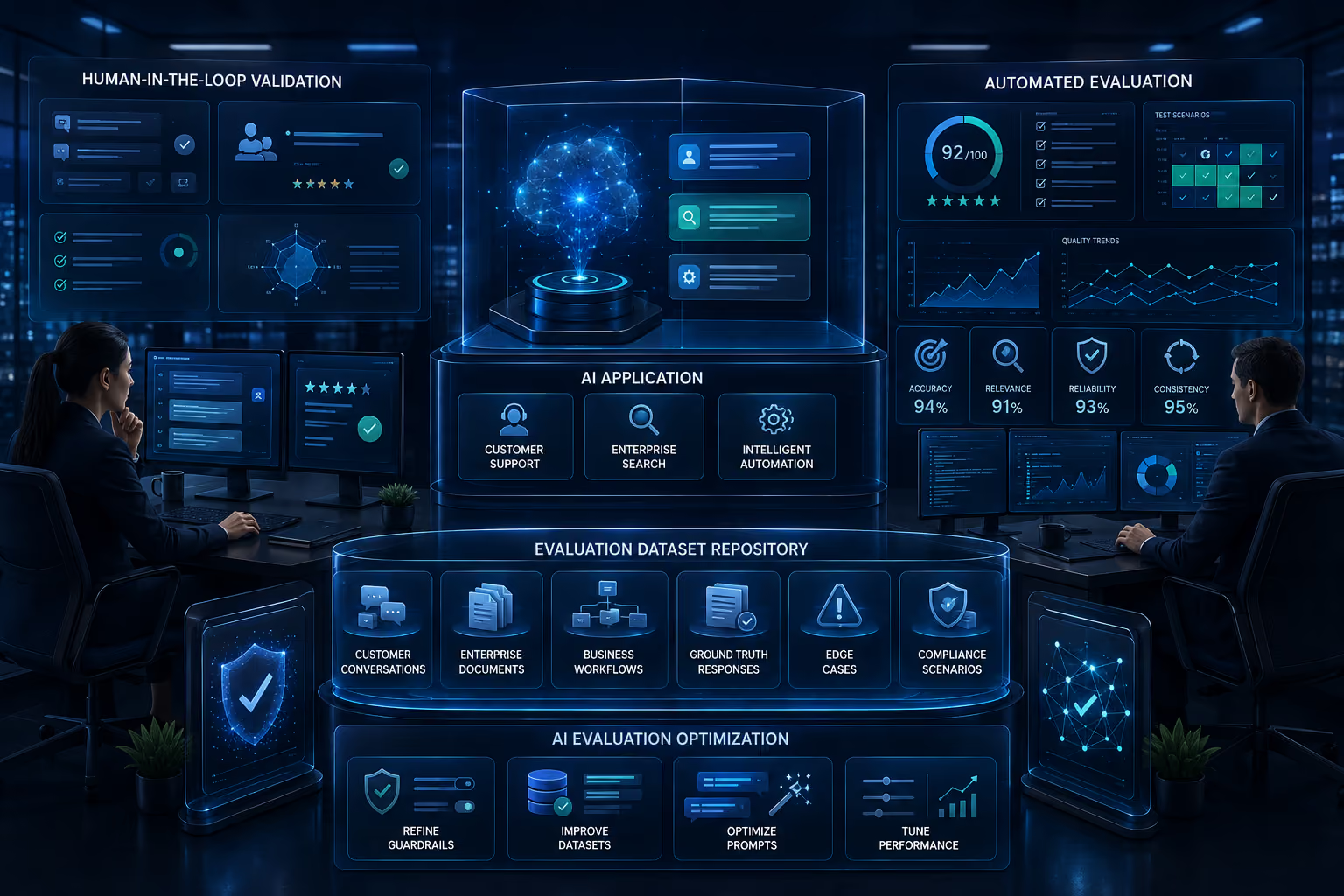
Whether the use case involves customer support, enterprise search, intelligent automation, or industry-specific AI solutions, WCT helps organizations:
The goal isn't simply to score AI outputs.
It's to ensure AI delivers reliable business outcomes.
The value of an AI system is not determined by the sophistication of the model behind it.
It's determined by whether the organization can consistently trust the system in real-world conditions.
AI Evals provide that confidence.
They create the structure needed to measure quality, maintain reliability, and continuously improve performance as business needs evolve.
As enterprise AI adoption accelerates, evaluation is no longer optional.
It's the foundation that transforms AI from a promising technology into a dependable business capability.
The organizations that lead with AI won't be the ones deploying the fastest. They'll be the ones that can prove their AI works consistently, repeatedly, and at scale.




Most organizations focus on building AI Models.
Far fewer focus on how they'll ensure it continues performing reliably.
The challenge is no longer whether AI can generate responses. It's whether those responses remain reliable across users, scenarios, and business conditions.
It may provide the correct information but use the wrong tone, miss critical context, or fail to align with business intent. At enterprise scale, these inconsistencies become business risks that affect customer experience, compliance, trust, and operational efficiency.
This is where AI evaluations, or AI Evals, become essential.
AI Evals go beyond measuring whether a system can generate a response. They measure whether it generates the right response consistently across different users, dimensions, regions, languages, and business scenarios.
A common misconception is that AI evaluation is simply checking whether the response is correct. In reality, enterprise evaluation measures whether a response meets business expectations as well as user expectations.
Consider a customer asking:
"Where's my order?"
An answer may be technically accurate and still create a poor experience.
A robust evaluation framework examines five dimensions:
1. Context: Did the system retrieve the correct order information, delivery timeline, and regional details?
2. Intent: Did it recognize that the customer is seeking reassurance, not just tracking data?
3. Relevance: Did it provide meaningful next steps or proactively explain a delay?
4. Tone: Did it reflect the organization's customer experience standards and brand voice?
5. Consistency: Would the response maintain the same quality across locations, languages, channels, and edge cases?
Most enterprise AI failures occur when one of these dimensions breaks, even when the answer itself is technically correct.
Together, these dimensions determine whether an interaction succeeds from a business perspective, not just a technical one.
A response can be accurate and still fail if it lacks empathy, misses context, or creates an inconsistent customer experience.
Enterprise AI isn't evaluated on answers alone. It's evaluated on outcomes.
Effective AI evaluation is not a launch milestone.
It's an operational discipline.
Leading organizations follow a continuous evaluation lifecycle:
Define Success:
Start by identifying the business outcomes that matter. Determine the scenarios, datasets, quality standards, and expected behaviors that define success for the use case. Success criteria should be tied not only to model performance, but also to customer experience, operational efficiency, compliance, and business value.
Build Evaluation Datasets:
Create representative evaluation datasets that reflect real-world interactions, business workflows, edge cases, exceptions, and high-risk scenarios. These datasets become the foundation for measuring AI quality, ensuring the system is tested against the situations it will encounter in production. As business needs evolve, datasets should continuously expand to capture new use cases, emerging risks, and changing user behavior.
Establish Baselines:
Use these benchmark datasets to define evaluation criteria and performance thresholds. Baselines provide a consistent reference point for measuring accuracy, relevance, groundedness, safety, consistency, and policy adherence over time.
Evaluate at Scale:
Use automated testing to assess performance across thousands of interactions, prompts, workflows, and dataset scenarios. Automated evaluations help identify quality issues, regressions, and performance gaps before they impact users.
Apply Human Judgment:
Not every quality signal can be measured automatically. Human reviewers assess nuance, intent, customer experience, business appropriateness, and contextual accuracy in ways automation cannot.
Improve Continuously:
As prompts, workflows, models, and datasets evolve, evaluations ensure improvements don't introduce regressions or compromise existing performance.
Much like software teams use regression testing to maintain application quality, AI teams use evaluations to maintain behavioural quality. The result is an AI system that improves confidently without sacrificing reliability.
As organizations expand their AI footprint, complexity grows quickly.
AI environments are constantly changing as models, prompts, business policies, and customer expectations evolve.
Without a structured evaluation framework, organizations often experience:
When evaluation breaks down, the impact extends beyond technology to customer trust, operational efficiency, and business adoption.
When users stop trusting AI systems, adoption slows and business value diminishes.
Evaluation provides the visibility and control needed to build confidence in AI at scale.
The strongest AI programs treat evaluation as a strategic capability, not a technical afterthought.
They measure how effectively AI contributes to business goals such as: Organizations can track evaluation performance directly against business KPIs such as customer satisfaction, operational efficiency, compliance, and workforce productivity.
Evaluation transforms AI performance from a subjective discussion into a measurable business outcome.
Instead of asking, "Is the model good?"
Organizations can ask: "Is the system delivering the results our business requires?"
That's a far more valuable question.
Building an enterprise-grade evaluation capability requires more than model expertise.
It requires the right combination of data, automation, governance, and human oversight.
WCT helps organizations develop that capability through three core areas:
Human-in-the-Loop Validation: Expert reviewers assess high-value interactions where judgment, nuance, and business context matter most.
Automated Evaluation: Scalable testing frameworks continuously measure AI quality, detect regressions, and support faster iteration.
AI Evaluation Optimization: Evaluation criteria, guardrails, and datasets are refined over time to align with evolving business requirements.
With dedicated datasets and use-case-specific evaluation frameworks, organizations gain a repeatable process for improving AI quality while maintaining consistency and control.
Whether the use case involves customer support, enterprise search, intelligent automation, or industry-specific AI solutions, WCT helps organizations:
The goal isn't simply to score AI outputs.
It's to ensure AI delivers reliable business outcomes.
The value of an AI system is not determined by the sophistication of the model behind it.
It's determined by whether the organization can consistently trust the system in real-world conditions.
AI Evals provide that confidence.
They create the structure needed to measure quality, maintain reliability, and continuously improve performance as business needs evolve.
As enterprise AI adoption accelerates, evaluation is no longer optional.
It's the foundation that transforms AI from a promising technology into a dependable business capability.
The organizations that lead with AI won't be the ones deploying the fastest. They'll be the ones that can prove their AI works consistently, repeatedly, and at scale.



.svg)
