




Thank you! Your submission has been received!
Oops! Something went wrong while submitting the form.



Across industries, enterprises are investing aggressively in AI, predictive analytics, intelligent automation, copilots, and advanced decision intelligence. Yet despite increased spending, a majority of AI initiatives fail to move beyond pilots or deliver sustainable business value.
The root cause is rarely the AI model.
It is the data platform underneath.
Legacy SQL Server environments, often on-premises, heavily customized, capacity-constrained, and operationally fragmented, were never designed to support the real-time, scalable, governed, and analytics-ready data foundations that modern AI workloads demand.
As organizations attempt to layer AI on top of aging data architectures, they encounter systemic friction: performance bottlenecks, data silos, governance gaps, escalating costs, and operational complexity. These challenges are not tactical, they are architectural.
This is why on-prem SQL databases to Azure SQL modernization has emerged as a critical enabler of enterprise AI success.
From a business perspective, AI failure manifests in familiar ways:
These symptoms point to deeper data platform misalignment.
Legacy SQL environments were optimized for transactional workloads, not continuous data ingestion, large-scale analytics, or AI-driven workloads. As enterprises scale data volumes, user concurrency, and analytical complexity, these platforms become fragile.
AI does not tolerate fragility.
The market has shifted decisively:
Meanwhile, enterprises are running hybrid estates, on-prem SQL Server, legacy reporting tools, siloed analytics environments, and emerging cloud services, all stitched together with fragile integrations.
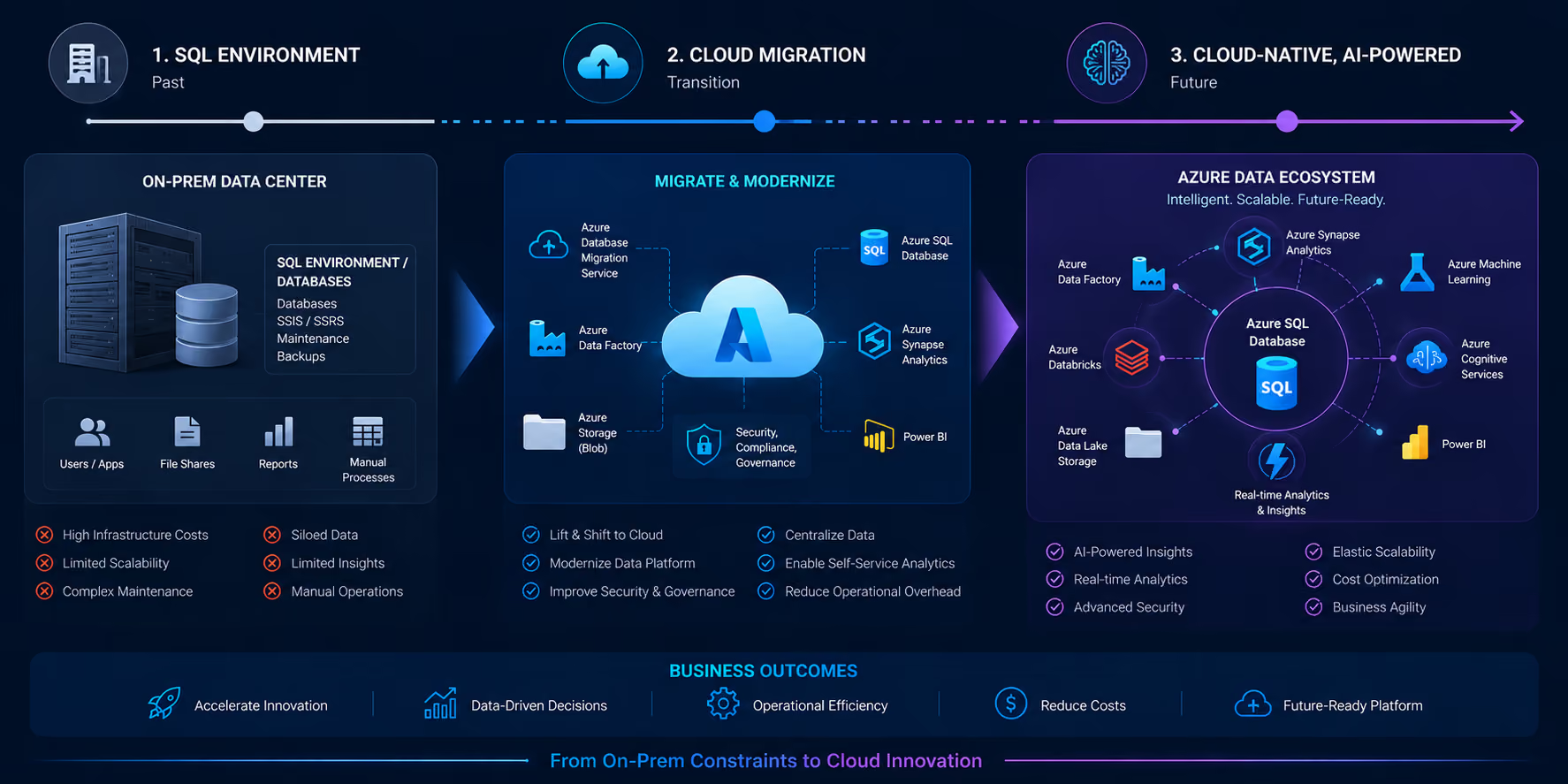
In this landscape, Azure SQL (Azure SQL Database and Azure SQL Managed Instance) offers a modernization path that preserves SQL compatibility while enabling:
Modernization is no longer about infrastructure refresh.
It is about data platform readiness for AI at scale.
AI workloads introduce unpredictable query patterns, large feature sets, and concurrency spikes. Legacy SQL environments struggle with:
AI thrives on unified, high-quality datasets. Legacy environments often suffer from:
Without centralized policies:
On-prem SQL environments demand:
These operational burdens slow innovation and inflate costs.
Successful enterprises treat modernization as a business transformation initiative, not a lift-and-shift exercise.
This approach allows organizations to modernize without rewriting applications, while unlocking AI-ready capabilities.
Modernization aligns IT capabilities with business ambition.
Enterprises must address:
WCT emphasizes phased modernization, combining assessment, pilot migrations, and production-scale rollout, ensuring continuity while modernizing confidently.
Azure SQL provides:
These capabilities are foundational for responsible AI adoption.
AI initiatives fail when they are built on platforms that cannot scale, govern, or perform.
Modernizing from SQL Server to Azure SQL is not a technology upgrade, it is a strategic prerequisite for AI-driven transformation.
WaferWire Cloud Technologies partners with enterprises to modernize data platforms with precision, governance, and measurable business impact, helping organizations turn AI ambition into operational reality.



Across industries, enterprises are investing aggressively in AI, predictive analytics, intelligent automation, copilots, and advanced decision intelligence. Yet despite increased spending, a majority of AI initiatives fail to move beyond pilots or deliver sustainable business value.
The root cause is rarely the AI model.
It is the data platform underneath.
Legacy SQL Server environments, often on-premises, heavily customized, capacity-constrained, and operationally fragmented, were never designed to support the real-time, scalable, governed, and analytics-ready data foundations that modern AI workloads demand.
As organizations attempt to layer AI on top of aging data architectures, they encounter systemic friction: performance bottlenecks, data silos, governance gaps, escalating costs, and operational complexity. These challenges are not tactical, they are architectural.
This is why on-prem SQL databases to Azure SQL modernization has emerged as a critical enabler of enterprise AI success.
From a business perspective, AI failure manifests in familiar ways:
These symptoms point to deeper data platform misalignment.
Legacy SQL environments were optimized for transactional workloads, not continuous data ingestion, large-scale analytics, or AI-driven workloads. As enterprises scale data volumes, user concurrency, and analytical complexity, these platforms become fragile.
AI does not tolerate fragility.
The market has shifted decisively:
Meanwhile, enterprises are running hybrid estates, on-prem SQL Server, legacy reporting tools, siloed analytics environments, and emerging cloud services, all stitched together with fragile integrations.
In this landscape, Azure SQL (Azure SQL Database and Azure SQL Managed Instance) offers a modernization path that preserves SQL compatibility while enabling:
Modernization is no longer about infrastructure refresh.
It is about data platform readiness for AI at scale.
AI workloads introduce unpredictable query patterns, large feature sets, and concurrency spikes. Legacy SQL environments struggle with:
AI thrives on unified, high-quality datasets. Legacy environments often suffer from:
Without centralized policies:
On-prem SQL environments demand:
These operational burdens slow innovation and inflate costs.
Successful enterprises treat modernization as a business transformation initiative, not a lift-and-shift exercise.
This approach allows organizations to modernize without rewriting applications, while unlocking AI-ready capabilities.
Modernization aligns IT capabilities with business ambition.
Enterprises must address:
WCT emphasizes phased modernization, combining assessment, pilot migrations, and production-scale rollout, ensuring continuity while modernizing confidently.
Azure SQL provides:
These capabilities are foundational for responsible AI adoption.
AI initiatives fail when they are built on platforms that cannot scale, govern, or perform.
Modernizing from SQL Server to Azure SQL is not a technology upgrade, it is a strategic prerequisite for AI-driven transformation.
WaferWire Cloud Technologies partners with enterprises to modernize data platforms with precision, governance, and measurable business impact, helping organizations turn AI ambition into operational reality.
1. Why do AI projects fail on legacy SQL Server platforms?
Because legacy platforms lack scalability, performance elasticity, governance, and real-time data capabilities required for AI workloads.
2. Is Azure SQL suitable for enterprise AI workloads?
Yes. Azure SQL provides elastic scaling, built-in intelligence, security, and seamless integration with Azure AI and analytics services.
3. Can we modernize SQL Server without rewriting applications?
Yes. Azure SQL maintains high SQL compatibility, enabling modernization without extensive application refactoring.
4. How does modernization improve AI ROI?
It reduces data prep time, improves performance, lowers infrastructure costs, and accelerates deployment cycles.
5. What governance benefits does Azure SQL provide?
Centralized security, auditing, encryption, access control, and compliance reporting.
6. Is hybrid modernization possible?
Yes. Azure SQL supports hybrid architectures for phased transitions.
7. How long does SQL to Azure SQL modernization take?
Timelines vary by complexity, but phased approaches minimize risk and disruption.
8. What AI services integrate natively with Azure SQL?
Azure OpenAI, Microsoft Fabric, Synapse, Power BI, and Azure Machine Learning.



.svg)
