



Thank you! Your submission has been received!
Oops! Something went wrong while submitting the form.



Java has been the foundation of enterprise applications for decades. From financial systems to large customer portals, many organizations still rely heavily on Java workloads built on older frameworks and heavyweight application servers.
But as digital transformation accelerates, these ageing systems are becoming a barrier, slowing delivery, increasing maintenance costs, and making it harder to adopt modern engineering practices.
To improve scalability, security, and delivery speed, enterprises are modernizing Java workloads to Azure Spring Apps and AKS, platforms designed for microservices and DevOps agility.
This guide breaks down the key decisions leaders must make, the common issues hidden in legacy Java systems, and how Azure services provide the foundation for secure, future-ready, cloud-native Java architectures.
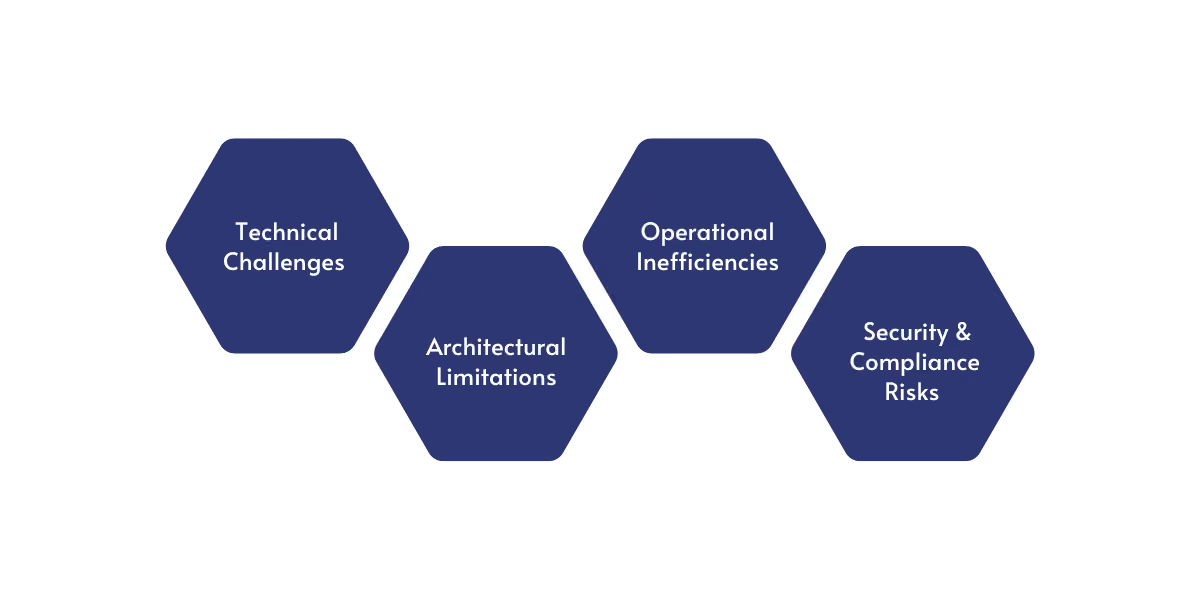
Many enterprise Java applications were built long before cloud-native practices, automation, and elastic scalability became essential. As a result, they now struggle to keep up with business demands, leading to higher costs, slower releases, and greater operational risk.
Below are the most common modernization blockers:
Aging Java technology stacks limit performance and cloud readiness.
Key issues:
Monoliths restrict agility and scalability as workloads grow.
Key issues:
Legacy deployment practices slow delivery and increase overhead.
Key issues:
Aging platforms create vulnerabilities that are difficult to monitor or patch.
Key issues:
These limitations impact performance, resiliency, and agility, making modernization essential for organizations aiming to stay competitive and innovate faster.
Also read: Application and Data Modernization Strategy: Steps for Success
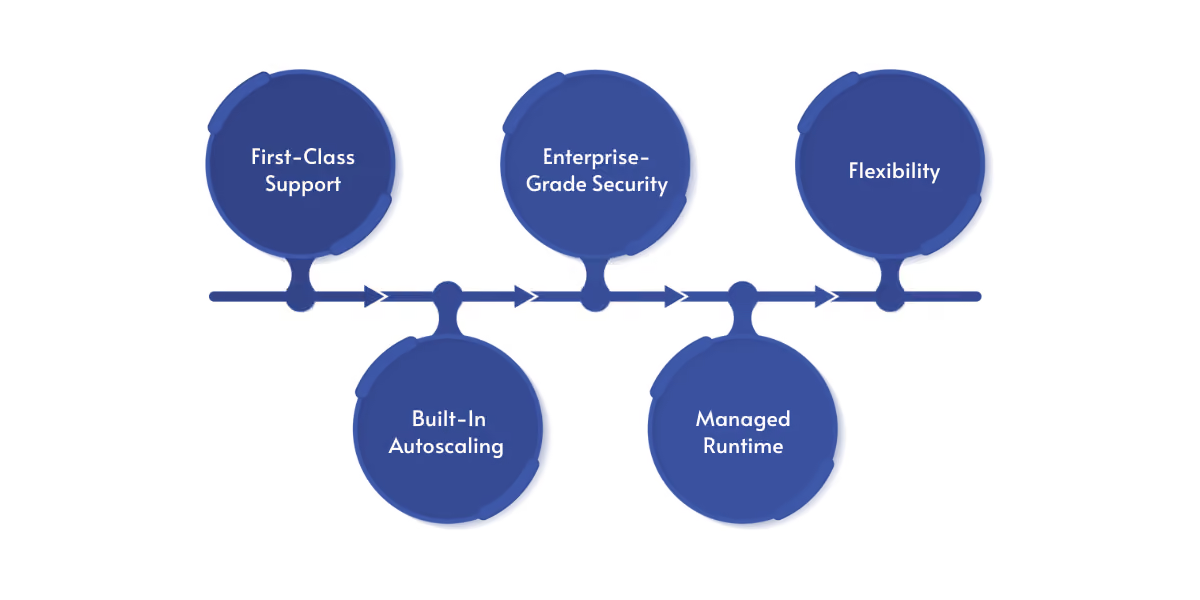
Azure gives enterprises the modern foundation needed to migrate Java workloads faster, while unlocking the scalability and automation that a digital environment demands.
Modernizing Java workloads isn’t only about performance, it directly improves cost efficiency across licensing, infrastructure, and operations. By eliminating legacy middleware, reducing on-prem footprint, and automating DevOps processes, enterprises see immediate and sustained financial gains.
Below is a simplified comparison of typical cost categories before and after modernization:
Suggested Read: Modernizing Business Processes for Digital Success
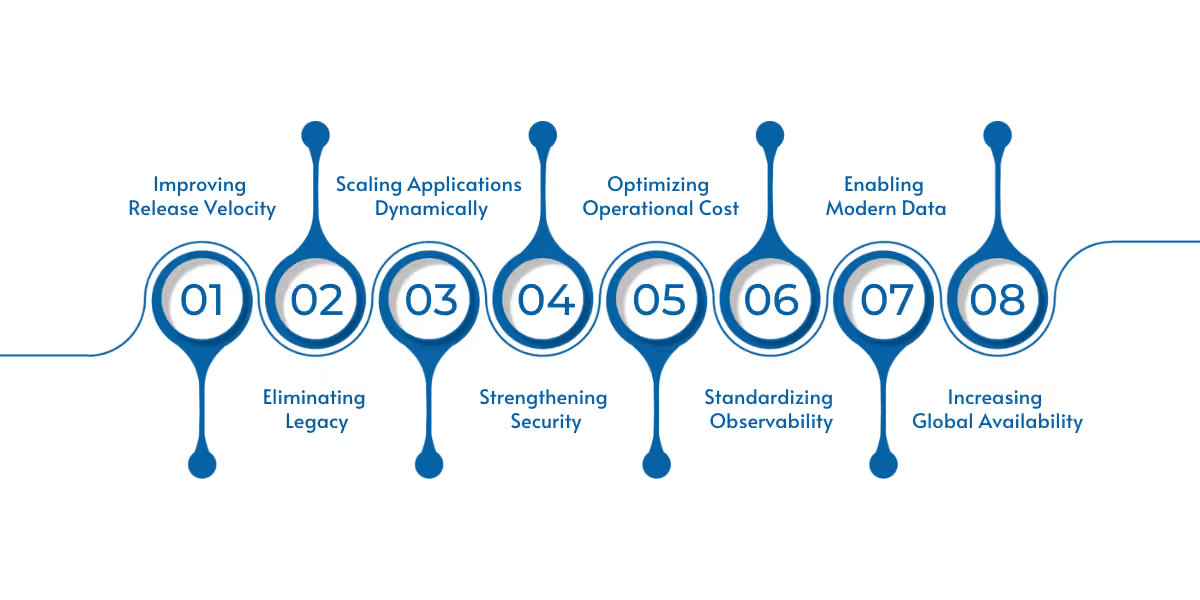
Here’s what CIOs and engineering leaders are prioritizing as they reshape their cloud roadmaps:
Suggested Read: Data Transformation in Microsoft Fabric- Best Practices Guide
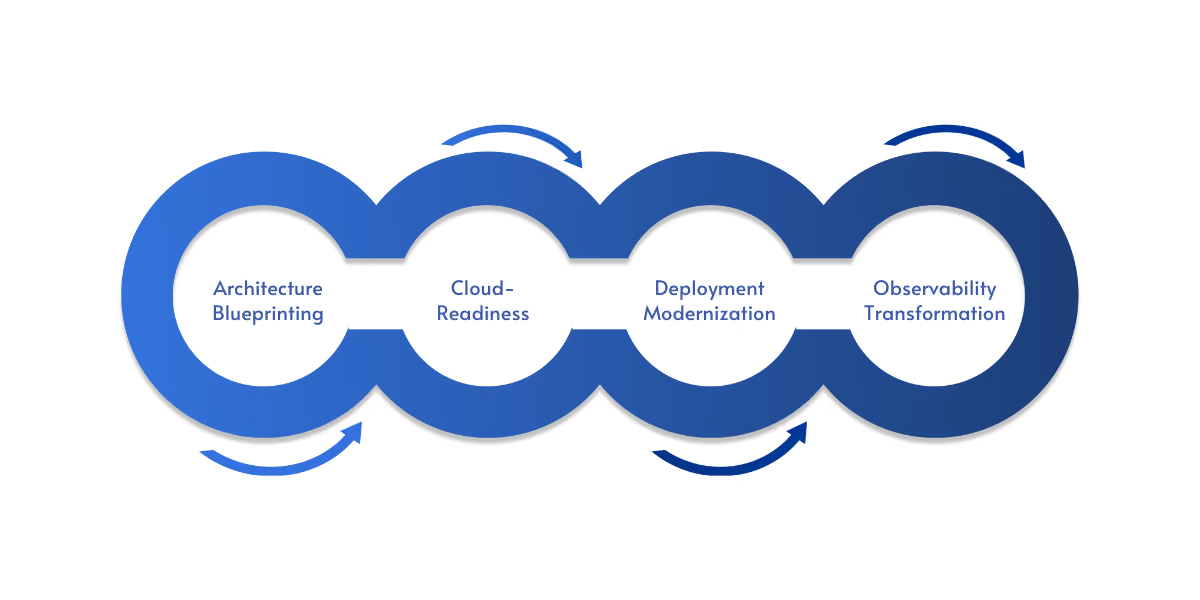
Enterprise Java modernization is complex, with outdated Java versions, heavy application servers (WebLogic, WebSphere), slow release cycles, high on-prem costs, and limited cloud readiness all contributing to stalled transformation.
WCT eliminates this risk and complexity with a proven, accelerator-driven framework built specifically for Java workloads moving to Azure Spring Apps and AKS.
Automated assessment to instantly uncover migration complexity:
Impact -50–60% faster assessment vs. traditional manual review
Modernizes applications to run efficiently in the cloud:
Outcome -Cloud-native Java with improved performance & compliance
WCT operationalizes deployment for scale and stability:
Impact -40% faster containerization effort
WCT enables modern delivery practices to improve developer velocity:
Result -2–3× faster deployments and reduced operational toil
Modernization success is not based on assumptions; it is proven through measurable engineering and business impact.
A major Healthcare & Life Sciences provider relied on a critical Java application for patient scheduling and care coordination across multiple hospitals. As demand increased, the limits of their legacy system became unavoidable:
Key challenges:
What WCT Delivered: Using the Java Modernization Readiness Analyzer, WCT defined a safe, fast modernization path without impacting patient care. Core systems were upgraded, containerized, and migrated to Azure Spring Apps Enterprise with fully automated deployment and unified monitoring.
WCT modernized:
Also read: Healthcare Modernization Strategies: Key Benefits for the Future
Cloud-native transformation doesn’t need to be disruptive or risky. With the right roadmap, tools, and expertise, it becomes a competitive advantage.
WCT helps organizations:
If you're exploring Azure Spring Apps or AKS, we’ll help you move forward with speed and confidence.
Curious how modernization could work for your stack? Book a consultation with WaferWire Today!



Java has been the foundation of enterprise applications for decades. From financial systems to large customer portals, many organizations still rely heavily on Java workloads built on older frameworks and heavyweight application servers.
But as digital transformation accelerates, these ageing systems are becoming a barrier, slowing delivery, increasing maintenance costs, and making it harder to adopt modern engineering practices.
To improve scalability, security, and delivery speed, enterprises are modernizing Java workloads to Azure Spring Apps and AKS, platforms designed for microservices and DevOps agility.
This guide breaks down the key decisions leaders must make, the common issues hidden in legacy Java systems, and how Azure services provide the foundation for secure, future-ready, cloud-native Java architectures.
Many enterprise Java applications were built long before cloud-native practices, automation, and elastic scalability became essential. As a result, they now struggle to keep up with business demands, leading to higher costs, slower releases, and greater operational risk.
Below are the most common modernization blockers:
Aging Java technology stacks limit performance and cloud readiness.
Key issues:
Monoliths restrict agility and scalability as workloads grow.
Key issues:
Legacy deployment practices slow delivery and increase overhead.
Key issues:
Aging platforms create vulnerabilities that are difficult to monitor or patch.
Key issues:
These limitations impact performance, resiliency, and agility, making modernization essential for organizations aiming to stay competitive and innovate faster.
Also read: Application and Data Modernization Strategy: Steps for Success
Azure gives enterprises the modern foundation needed to migrate Java workloads faster, while unlocking the scalability and automation that a digital environment demands.
Modernizing Java workloads isn’t only about performance, it directly improves cost efficiency across licensing, infrastructure, and operations. By eliminating legacy middleware, reducing on-prem footprint, and automating DevOps processes, enterprises see immediate and sustained financial gains.
Below is a simplified comparison of typical cost categories before and after modernization:
Suggested Read: Modernizing Business Processes for Digital Success
Here’s what CIOs and engineering leaders are prioritizing as they reshape their cloud roadmaps:
Suggested Read: Data Transformation in Microsoft Fabric- Best Practices Guide
Enterprise Java modernization is complex, with outdated Java versions, heavy application servers (WebLogic, WebSphere), slow release cycles, high on-prem costs, and limited cloud readiness all contributing to stalled transformation.
WCT eliminates this risk and complexity with a proven, accelerator-driven framework built specifically for Java workloads moving to Azure Spring Apps and AKS.
Automated assessment to instantly uncover migration complexity:
Impact -50–60% faster assessment vs. traditional manual review
Modernizes applications to run efficiently in the cloud:
Outcome -Cloud-native Java with improved performance & compliance
WCT operationalizes deployment for scale and stability:
Impact -40% faster containerization effort
WCT enables modern delivery practices to improve developer velocity:
Result -2–3× faster deployments and reduced operational toil
Modernization success is not based on assumptions; it is proven through measurable engineering and business impact.
A major Healthcare & Life Sciences provider relied on a critical Java application for patient scheduling and care coordination across multiple hospitals. As demand increased, the limits of their legacy system became unavoidable:
Key challenges:
What WCT Delivered: Using the Java Modernization Readiness Analyzer, WCT defined a safe, fast modernization path without impacting patient care. Core systems were upgraded, containerized, and migrated to Azure Spring Apps Enterprise with fully automated deployment and unified monitoring.
WCT modernized:
Also read: Healthcare Modernization Strategies: Key Benefits for the Future
Cloud-native transformation doesn’t need to be disruptive or risky. With the right roadmap, tools, and expertise, it becomes a competitive advantage.
WCT helps organizations:
If you're exploring Azure Spring Apps or AKS, we’ll help you move forward with speed and confidence.
Curious how modernization could work for your stack? Book a consultation with WaferWire Today!
1. How do I know if my Java applications are ready for cloud modernization?
If your workloads rely on older Java versions, monolithic architectures, high licensing costs, or manual deployment processes, modernization should be prioritized. A readiness assessment will identify gaps in compatibility, performance, and cloud-native readiness.
2. What is the difference between Azure Spring Apps and AKS for Java workloads?
Azure Spring Apps is best for Spring Boot applications that benefit from a fully managed runtime, built-in scaling, and automated deployments. Azure Kubernetes Service (AKS) is ideal for modular, containerized Java microservices with Kubernetes governance, granular control, and multi-service scaling.
3. How long does a typical Java modernization take?
Without accelerators, modernization programs can take six to twelve months, depending on app size and complexity. WCT’s automation and structured frameworks help reduce timelines by 30 to 60 percent.
4. What business outcomes can we expect after modernizing to Azure?
Organizations typically achieve:
• 2 to 3 times faster release cycles
• 30 to 40 percent lower infrastructure cost
• Higher application resilience with 99.95 percent uptime
• Improved security posture with managed cloud controls
5. How does WCT ensure minimal disruption during modernization?
WCT follows a phased, zero-downtime modernization approach with automated code scanning, parallel cloud deployments, and controlled cutover strategies, keeping business operations fully functional throughout the transition.




.svg)
